
Self-Rising Biscuits

The kids let us sleep in this morning, which was a happy surprise. However, it meant that it was nearly “brunch time” by the time we rolled out of bed. Everyone wanted breakfast and had their own ideas of what it should be. One wanted pancakes, the other expected French toast – another suggested outside options. In an effort to avoid that, I remembered this recipe, and that I had the all important eggs and bacon! These biscuits came together quickly and were so easy to make. I cut the biscuits into squares to save time and avoid overworking the dough and piecing the scraps together to make more biscuits.  We enjoyed these sandwich style, but my favorite way is with butter and apricot preserves 🙂

I posted earlier this week about receiving a free bag of King Arthur Unbleached Self-Rising flour, and I thought I should give my opinion of it. I am a loyal KAF customer and have at least 3 different types of flour from this brand; so, it comes as no surprise to me that I would love working with this 🙂 . Their website is full of recipes, and my family and friends favorite one so far is the fudge brownies! I also have several specialty items I have purchased through the online shop, and the quality is superior and I always get consistent results with my baked goods. What I appreciated even before I opened the bag was that it’s unbleached. I have yet to find another company that makes unbleached, self-rising flour – which leads to the other unique quality: aluminum free baking powder. Because it’s aluminum-free, there is no weird “tinny” flavor, so your baked goods will be light, fluffy and flavorful! Thanks for reading, enjoy!

Up Next: Chocolate Cobbler

Easy Self-Rising Biscuits – from King Arthur Flour

Directions:

1) Preheat the oven to 425°.

2) Place the flour in a bowl. Work in the butter or shortening just until crumbs are the size of large peas.

3) Add 2/3 cup of the milk or buttermilk, and stir until the mixture holds together and leaves the sides of the bowl, adding more milk or buttermilk if needed.

4) Scoop the dough onto a well-floured surface, and fold it over on itself several times, using more flour as needed to prevent sticking.

5) Roll or pat the dough into a 5″ x 8 1/2″ rectangle about 1/2″ to 3/4″ thick.

6) Cut biscuits with a sharp, round 2″ cutter, dipping the cutter into flour between cuts to reduce sticking. Or cut the rectangle into 12 small rectangular biscuits, which will allow you to skip the step of re-rolling and cutting scraps.

7) If you’ve used a round cutter, pat the scraps together, and cut additional biscuits.

8) Place the biscuits on an ungreased baking sheet, leaving about 1″ between them for crisp biscuits. Arrange biscuits so they’re barely touching for soft-side biscuits. For higher-rising soft-side biscuits, place biscuits in an 8″ round pan.

9) Bake the biscuits for 10 to 14 minutes, or until they’re a light golden brown.

10) Remove them from the oven, and serve hot. Cool leftovers completely, wrap airtight, and store at room temperature for several days; freeze for longer storage. To refresh room-temperature biscuits, place on a baking sheet, tent lightly with foil, and bake in a preheated 350°F oven for 10 to 13 minutes, until heated through.

Yield: about 1 dozen 2″ biscuits.

Sweet!!

Look what came in the mail today! I’m pretty excited and even more flattered that KAF contacted me about this brand new flour they now offer. I saw this in the Summer catalog a couple of weeks ago, and figured my store may never carry this one – at least not any time soon. To my surprise and delight, I received and email with an offer of this free bag of flour if I agreed to blog about it and link back to King Arthur Flour. I use KAF flour in all my baking (I’m an unashamed food snob, as I have mentioned in the past), so that request was not a problem at all for me! 🙂 I trust this brand with all my baked goods, and my pantry is full of products that I have only found via KAF’s online store! Now I’m on the look out for the perfect recipe to try this out on. If you have any suggestions, I would love to hear from you. Thanks for reading 🙂

Whole Wheat Sandwich Bread

Yes, it came out a little – okay, a lot wonky…but I have issues with braids on top of loaves. I didn’t tuck the braid underneath the loaf, and this is what happens. I should know by now that patience and reading through the full recipe is rewarded. Don’t be like me! 😉 However, in the end what the food looks like isn’t nearly as important as how it tastes.

Verdict: S calls this “cloud bread” and didn’t seem to mind that this is wheatier than other loaves I usually make. This bread tastes great and isn’t bitter from all the wheat flour. It’s also surprisingly soft and squishy, but not so soft that it fell apart while eating my sandwich. Thanks for reading, enjoy!

Whole Wheat Bread – adapted from My Kitchen Addiction

  • 2 tablespoons orange juice
  • 1 cup lukewarm water
  • 2 1/2 teaspoons instant yeast (or one packet)
  • 3 tablespoons granulated sugar
  • 1/2 cup plain Greek yogurt
  • 1/4 cup canola oil
  • 1 teaspoon salt
  • 1 cup bread flour (King Arthur)
  • 3+ cups white whole wheat flour (King Arthur)

In a large mixing bowl, combine the water and the orange juice.  Sprinkle with the yeast and granulated sugar, and stir to dissolve.  Add the yogurt, canola oil, salt, and cup of bread flour.  Use a wooden spoon to mix, beating vigorously to start to develop the gluten in the bread flour.  Gradually, add the whole wheat flour, mixing with the wooden spoon until the dough pulls away from the sides of the bowl to form a ball. At that point, turn the dough out onto a clean, floured surface, and knead until you have a smooth dough (about 6-8 minutes). The amount of whole wheat flour needed will vary on the humidity and other factors.  Add just enough flour to keep the dough from sticking to your hands as you knead.

Return the dough to a lightly greased bowl, cover (with plastic wrap or a damp towel), and let rise until the dough has doubled (about an hour or two). It has risen sufficiently when the imprint of your fingers remains and the dough doesn’t spring back up.

Punch down the dough and form it into the shape of a loaf.  If you prefer, you can make a braid-topped loaf (like the one in my pictures) by reserving 1/3 of the dough, dividing it into three long strands, and creating a braid.  Place the braid on top of the loaf, tucking in the ends.  Place the shaped loaf into a greased loaf pan, cover, and let rise for an additional hour.

Preheat the oven to 350°F.  Bake the bread uncovered for 15 minutes, then cover with aluminum foil (to prevent over-browning on the top) and bake for an additional 20 – 25 minutes.  The internal temperature of the bread should be 190°F when the bread is done. Let the bread rest in the pan for a minute or two before transferring it to a wire rack to cool.  Cool for at least 30 minutes before slicing.

One Loaf Basic Bread and One Cinnamon-Raisin Swirl

I like when recipes offer variations like this one – it’s like two for the price of one 😉  It was just me and the kids this week as M was off checking out an IBM convention for work. When he’s away I like to take advantage of not worrying if he will like something I make or not. See – he doesn’t like onions, bell peppers, mushrooms, mustard or raisins. He says he’s not picky, and believe me I have met some picky eaters – but those foods he refuses are often main components to so many recipes! It really ruins meal planning for me at times. The kids and I love raisins and I don’t often get to make a loaf like this one. Besides, it had been a couple of months since last I made French toast.
These loaves came out nicely with a tight, but not dense crumb – perfect for hearty sandwiches, grilled cheese or toast. I will make this one again with my modifications. I can’t justify using all white flour in any of my loaves, and I find if I substitute one-third of the flour with white whole wheat, my family doesn’t complain 🙂
Walter Sands’ Basic White Bread and Cinnamon-Swirl Variation – adapted from King Arthur Flour
  • 2 cups warm water
  • 2 tablespoons raw sugar
  • 1 packet active dry yeast
  • 1/2 cup Bakes’s Special dry milk (71 grams)
  • 2 tablespoons soft butter
  • 4 cups (500 grams) AP Flour
  • 2 cups (240 grams) white whole wheat flour
  • 2 teaspoons salt

cinnamon-raisin swirl – (I used half this amount)

  • 3 tablespoons butter, melted and cooled
  • 1 cup raisins
  • 1/2 cup brown sugar
  • 1 teaspoon cinnamon
Directions: 

1) Pour the warm water into a mixing bowl. Add and let dissolve the sugar or honey and then the yeast.

2) When the yeast is bubbling, add the butter, 3 cups of flour, the dry milk, and salt. Mix together.

3) Stir in another 2 1/2 cups of flour, keeping the last 1/2 cup in reserve. Knead the dough for 3 to 4 minutes, until it begins to behave as if it belongs together. Cover and let the dough rest while you clean and grease the mixing bowl.

4) Continue kneading for 3 or 4 more minutes, until the dough feels smooth and springy.

5) Place the bowl in the greased bowl, turn it over to coat both sides, and cover the bowl. Let it rise in a draft-free place until doubled, 1 to 2 hours. Deflate the dough, and divide it in half. For cinnamon-swirl bread, roll each piece of dough into a rough 9″ x 15″ rectangle. Spread each piece with half the melted butter, then sprinkle with half the raisins, sugar, and cinnamon. Starting with a short edge, roll into a cylinder. Place the loaves in the pans, seam-side down, and let rise and bake as directed at right., and place in greased 8 1/2″ x 4 1/2″ pans. Cover with greased plastic wrap and let rise until the dough domes an inch above the rim of the pans.

6) After the dough has been rising for 20 minutes, preheat the oven to 350°F. When the loaves are sufficiently risen, bake for 35 to 40 minutes, or until nicely browned and the center of the loaves reads 190°F when measured with an instant-read thermometer. Remove from the oven and tip the breads out of their pans. Place on a rack to cool completely before slicing.

This is our favorite recipe for custard and I have been using it for years. I have tried others, but this is the best in my opinion. Dry out your bread slices overnight, or spread the pieces on a cooling rack placed on a sheet pan at 350 degrees for 5 minutes. I soaked the raisins in hot water before I put them on the dough, but I didn’t have time to let them drain for very long. That’s why the loaf didn’t stay together at the top. All that steam built up underneath and created a big air bubble all the way through. Thankfully, it tastes better than it looks! Thanks for reading, enjoy 🙂

English Muffin Bread

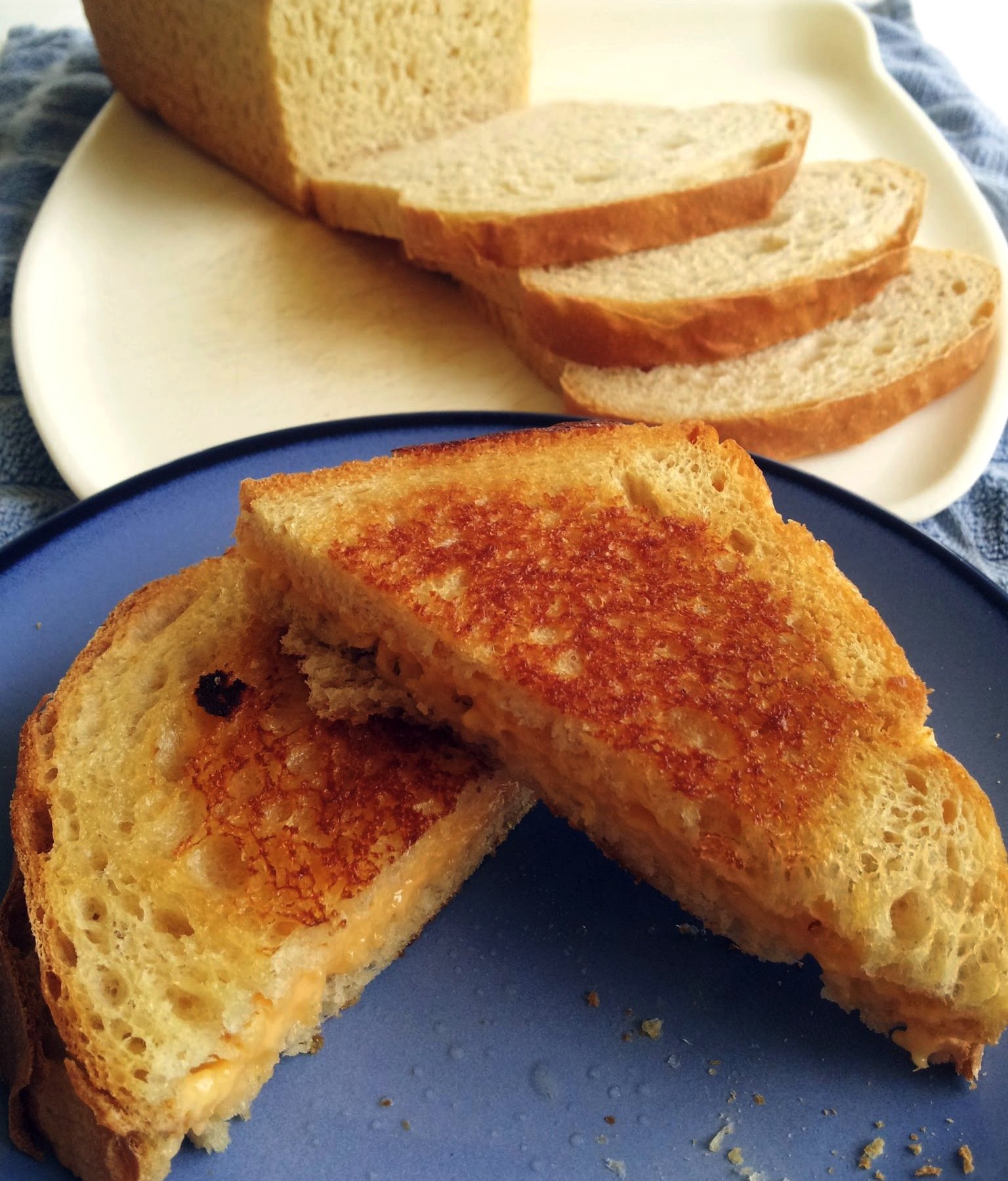
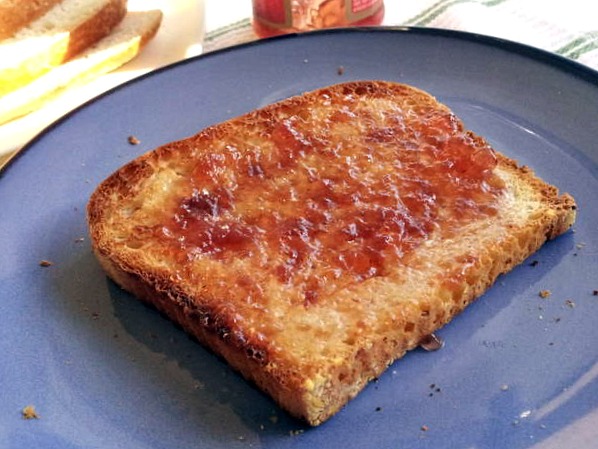
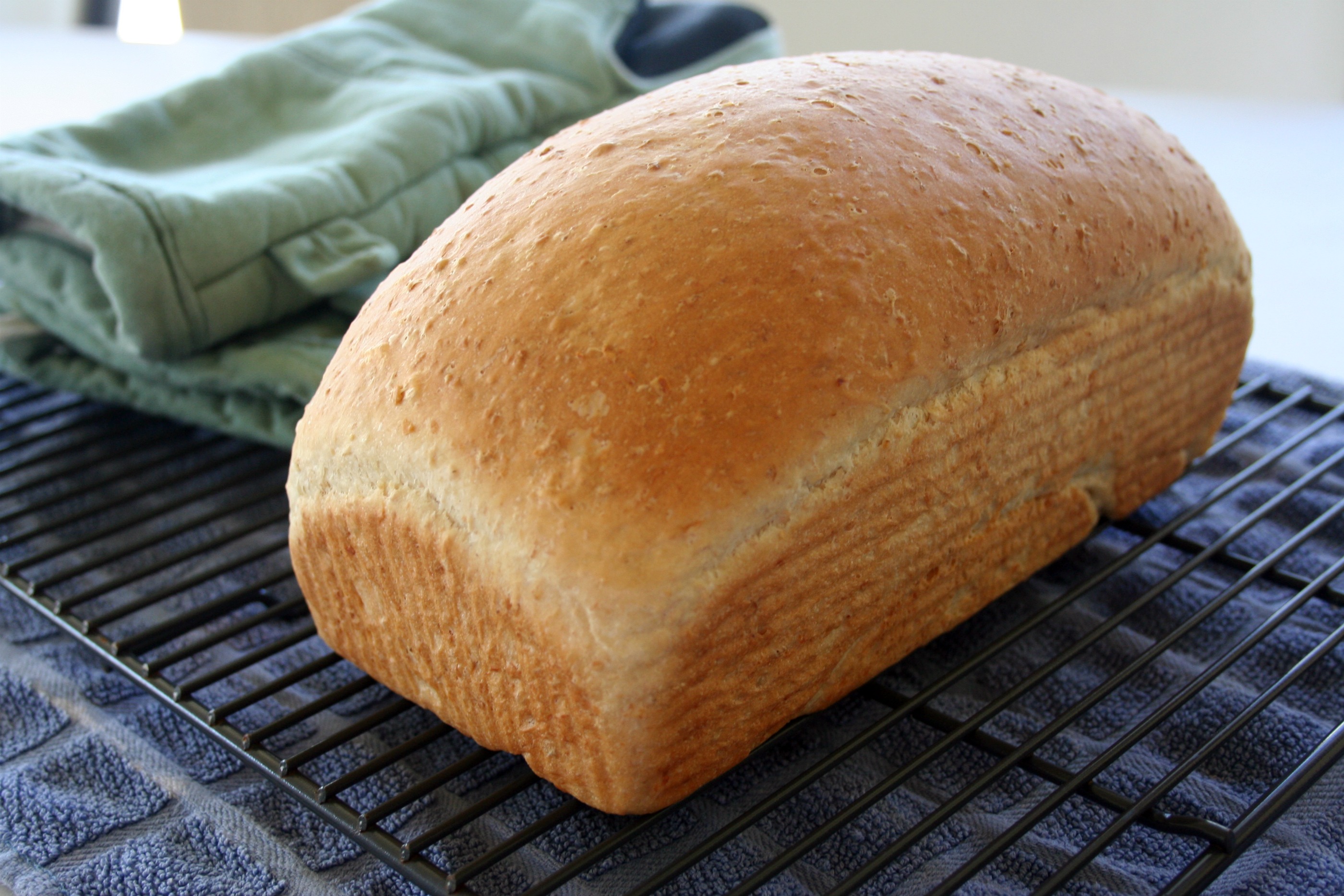
Quick Post: This bread couldn’t be easier! It doesn’t require kneading, either – mix it up, dump it in the pan, rest and bake. It finished loaf is light, the interior is moist and full of holes which become super crunchy when toasted. It’s so weird that this really is similar to an English muffin with all the nooks and crannies. The butter, honey or jam fills all the holes up and makes for a really crunchy and tasty toast. Thanks for reading, enjoy!

**My Canon camera is not working right at all! (sad face) I have to take pictures with my phone until I can get a new one…**

English Muffin Toasting Bread – adapted from King Arthur Flour

  • 3 cups ap flour (I used bread flour)
  • 1 tablespoon sugar
  • 1 1/2 teaspoons salt
  • 1/4 teaspoon baking soda
  • 1 tablespoon yeast
  • 1 cup milk
  • 1/4 cup water
  • 2 tablespoons vegetable oil or olive oil
  • cornmeal, to sprinkle in pan
Directions –

1) Whisk together the flour, sugar, salt, baking soda, and instant yeast in a large mixing bowl.

2) Combine the milk, water, and oil in a separate, microwave-safe bowl, and heat to between 120°F and 130°F. Be sure to stir the liquid well before measuring its temperature; you want an accurate reading. If you don’t have a thermometer, the liquid will feel quite hot (hotter than lukewarm), but not so hot that it would be uncomfortable as bath water.

3) Pour the hot liquid over the dry ingredients in the mixing bowl.

4) Beat at high speed for 1 minute. The dough will be very soft.

5) Lightly grease an 8 1/2″ x 4 1/2″ loaf pan, and sprinkle the bottom and sides with cornmeal

6) Scoop the soft dough into the pan, leveling it in the pan as much as possible.

7) Cover the pan, and let the dough rise till it’s just barely crowned over the rim of the pan. When you look at the rim of the pan from eye level, you should see the dough, but it shouldn’t be more than, say, 1/4″ over the rim. This will take about 45 minutes to 1 hour, if you heated the liquid to the correct temperature and your kitchen isn’t very cold. While the dough is rising, preheat the oven to 400°F.

8) Remove the cover, and bake the bread for 22 to 27 minutes, till it’s golden brown and its interior temperature is 190°F.
9) Remove the bread from the oven, and after 5 minutes turn it out of the pan onto a rack to cool. Let the bread cool completely before slicing.

Honey Oat Bread

I love bread! This one is a little sweet, buttery, moist and delicious. It makes perfect toast because all that buttery, sweet, oaty-ness is turned up. The recipe is for a pullman pan, but offers the conversion for a large, 9×5 loaf pan. It just takes longer to bake, about 40 minutes. Be sure to check its temperature before de-panning. Thanks for reading, enjoy!

Honey Oat Bread – adapted from King Arthur Flour

  • 3 cups AP flour
  • 2 1/4 teaspoons yeast
  • 1 cup old-fashioned rolled oats (not quick oats)
  • 1 1/2 teaspoons salt
  • 4 tablespoons melted butter
  • 3 tablespoons honey
  • 1 cup to 1 cup + 2 tablespoons lukewarm water*
  • *Use the smaller amount in the summer, or in a humid climate; the larger in winter, or in a drier climate.

1) Combine all of the ingredients, and mix until cohesive. Cover the bowl, and let the dough rest for 20 minutes, to give the oats a chance to absorb some of the liquid. Then knead — by hand, stand mixer, or bread machine — to make a smooth, soft, elastic dough.

2) Place the dough in a lightly greased bowl, or in an 8-cup measure (so you can track its progress as it rises), and let it rise for 1 to 1 1/2 hours, until it’s risen noticeably. It won’t necessarily double in bulk.

3) Gently deflate the dough, and shape it to fit into a 9×5 loaf pan. Cover lightly with plastic wrap and let rise until the loaf crests over the pan by one inch. Preheat your oven to 350 during the last 15 to 20 minutes of the rise time.

4) Remove the plastic and place in the center of the oven, bake for 40 to 45 minutes or until a thermometer inserted in the center registers at least 190 degrees F.

7) Remove the bread from the oven, and turn it out of the pan onto a rack. Run a stick of butter over the top, if desired; this will yield a soft, buttery crust. Cool completely before cutting; wrap airtight and store for several days at room temperature.

Yield: 1 standard loaf.

Beautiful Burger Buns

I love that I save money making buns like this at home. They’re fresh, free of preservatives and artificial ingredients and so much more flavorful than anything you can find at Publix. The only down-side to making so many different things at home is that I’ve ruined my son’s chances at finding a wife who does the same. He’s mindful of the things I make asking if it’s “from scratch” and couldn’t stop telling me last night how my cooking is the “best in the world”:) Anyway, I used these for this sandwich and they were a good fit for because they held up well to all the sandwich ingredients without falling apart. Thanks for reading, enjoy!

Beautiful Burger Buns – adapted from King Arthur Flour

  • 3/4 to 1 cup lukewarm water
  • 2 tablespoons butter
  • 1 large egg
  • 3 1/2 cups all-purpose flour
  • 1/4 cup sugar
  • 1 1/4 teaspoons salt
  • 1 tablespoon instant yeast

Directions –

1. Mix and knead all of the dough ingredients – by hand, mixer, or bread machine – to make a soft, smooth dough.

2. Cover the dough, and let it rise for 1 hour, or until it’s doubled in bulk.

3. Gently deflate the dough, and divide it into 8 pieces. Shape each piece into a round 1″ thick (more or less); flatten to about 3″ across. Place the buns on a lightly greased baking sheet, cover, and let rise for about an hour, until very puffy.

4. If desired, brush buns with melted butter. Or brush lightly with egg wash (1 egg beaten with 1 tablespoon water), and sprinkle with sesame seeds.

5. Bake the buns in a preheated 375 degree oven for 12 to 15 minutes, till golden. Cool on a rack.


Cinnamon Swirl Bread

A few days ago, I decided that I would make French toast; and today I thought: “why not make that cinnamon swirl bread I bookmarked so long ago?” Sure, it takes a little more effort but my family is worth it! This recipe is actually a raisin/cinnamon swirl bread – but M doesn’t like raisins so, I left them out.

The recipe was simple enough to follow, but not as straight forward as my favorite sandwich bread recipe. The dough is super soft and kind of sticky once it’s all finished kneading – but don’t worry! After its first rise and quick chill in the freezer, it was much easier to work with. Rolling it out was simple enough because it didn’t snap back like other doughs. Next time I will roll the dough out slightly smaller so I don’t have so much to tuck underneath. That explains the wonky look of my loaf. It’s not going to win any perfect loaf contest, but I’m sure the family won’t mind.

For the custard, I used this recipe but with slightly less sugar. The sweetness in the dough should be plenty to make up for that.

Verdict: this was worth the effort. Everyone enjoyed the French toast this morning! It did take longer to cook than I anticipated, because I dried out the bread in the oven at 350 for about 8 minutes so the bread would absorb the custard well and not fall apart. Once one batch was finished, I placed the slices on a rack which I place on top of a half sheet pan into a 200 degree oven to keep warm. Serve with lots of warm maple syrup! Thanks for reading, enjoy:)

Cinnamon Swirl Bread – adapted from Dorie Greenspan via food.baby

For the bread:

  • 1 packet active dry yeast
  • 1/4 cup sugar, plus a pinch
  • 1 1/4 cups just-warm-to-the-touch whole milk
  • 1/2 stick (4 tablespoons) unsalted butter, at room temperature
  • 3/4 teaspoon salt
  • 1 large egg
  • 1/4 teaspoon pure vanilla extract (optional)
  • Grated zest of 1/2 orange (optional)
  • Pinch of freshly grated nutmeg (optional)
  • 3 3/4 to 4 cups all-purpose (plain) flour

For the swirl:

  • 1 tablespoon sugar
  • 2 teaspoons ground cinnamon
  • 2 teaspoons unsweetened cocoa powder (optional)
  • 1 cup moist, plump raisins (dark or golden)
  • 3 tablespoons unsalted butter, softened to a spreadable consistency

To make the bread:

Put the yeast in a small bowl, toss in the pinch of sugar and stir in 1/4 cup of the warm milk. Let rest for 3 minutes, then stir – the yeast may not have dissolved completely and it may not have bubbled, but it should be soft.

Working with a stand mixer, preferably fitted with a paddle attachment, combine the remaining 1 cup of milk, the butter and the remaining 1/4 cup sugar and mix for a minute or two. Add the salt, egg and vanilla, if you are using it, as well as the zest and nutmeg, if you’re using them, and mix for a minute. In all likelihood, the mixture will look unpleasantly curdly (it will look even worse when you add the yeast). Add the yeast mixture and beat on low-medium speed for 1 minute more.

Turn the mixer off and add 2 3/4 cups of the flour. Mix on low speed just until you work the flour into the liquids – you’ll have a sticky mix. If you’ve got a dough hook, switch to it now. Add another 1 cup of flour, increase the mixer speed to medium and beat the dough for a couple of minutes. If the dough does not come together and almost clean the sides of the bowl, add up to 1/4 cup more flour, 1 tablespoon at a time. Keep the mixer speed at medium and knead the dough for about 3 minutes, or until it is smooth and has a lovely buttery sheen. The dough will be very soft, much too soft to knead by hand.

Butter a large bowl, turn the dough into a bowl and cover the bowl tightly with plastic wrap. Put the bowl in a warm place and let the dough rise until it is doubled in size, about 1 1/2 hours.

Scrape the dough onto a large piece of plastic wrap, wrap it and put it in the freezer for 30 minutes to firm enough to be rolled easily. (At this point, you can instead refrigerate the dough overnight if that is more convenient).

To make the swirl and shape the loaf:

Butter a 9 x 5 inch loaf pan.

Whisk together the sugar, cinnamon and cocoa, if you’re using it. Check that the raisins are nice and moist; if they’re not, steam them for a minute, then dry them well.

Put the dough on a large work surface lightly dusted with flour, lightly dust the top of the dough and roll the dough into a rectangle about 12 x 18 inches.

Gently smear 2 tablespoons of the butter over the surface of the dough – this is most easily done with your fingers. Sprinkle over the sugar mixture and scatter over the raisins. Starting from a short side of the dough, roll the dough up jelly-roll fashion, making sure to roll the dough snugly. Fit the dough into the buttered pan, seam side down, and tuck the ends under the loaf.

Cover the pan loosely with wax paper and set in a warm place; let the dough rise until it comes just a little above the edges of the pan, about 45 minutes.

Getting ready to bake:

When the dough has almost fully risen, centre a rack in the oven and preheat the oven to 375 degrees F (190 degrees Celsius). Line a baking sheet with parchment or a silicone mat.

Melt the remaining tablespoon of butter, and brush the top of the loaf with the butter. Put the pan on the baking sheet and bake the bread for about 20 minutes. Cover loosely with a foil tent and bake for another 25 minutes or so, until the bread is golden and sounds hollow when the bottom of the pan is tapped. Transfer the pan to a rack and cool for 5 minutes, then unmold. Invert the bread and cool to room temperature right side up on the rack.

Chewy Triple Chocolate Cookies

M requested something “triple chocolate” the other day, so off to Tastespotting.com I went. I meant to bake these up for Valentine’s Day, but I didn’t get around to it…oh, well! Today was a good day for cookies and these are rich, moist and fudgy. I don’t choose chewy cookies for myself (store-bought chewy cookies ruined them for me), but these have a pleasing soft and chewy texture. They do take more time, but not too much more effort than the average cookie recipe. Be sure to read ahead in these directions before making them – I didn’t know the dough needed to sit 30 minutes before I could dish them out. The cookies need to cool on the baking sheets for a full ten minutes before being transferred to a cooling rack, too. Make sure you have lots of chocolate on hand before deciding to make these. M wanted some cookies so bad, he was willing to make a quick trip to the store to pick up more chocolate. I needed almost a full two pounds! Thankfully this recipe makes nearly four dozen cookies, so you can spread the love around by passing these out to friends and family…better to do that than be tempted to eat them all!;) Thanks for reading, enjoy!

Chewy Triple Chocolate Cookies – adapted from Annie’s Eats

  • 2 cups (10 oz.) all-purpose flour
  • 1/2 cup (1 1/2 oz.) Dutch-processed cocoa powder
  • 2 tsp. baking powder
  • 1/2 tsp. salt
  • 16 oz. semi-sweet chocolate, chopped (I used two bars of semi-sweet and two of bitter sweet)
  • 4 large eggs
  • 2 tsp. vanilla extract
  • 2 tsp. instant coffee or espresso powder
  • 10 tbsp. unsalted butter, softened but still cool
  • 1 1/2 cups packed (10 1/2 oz.) light brown sugar
  • 1/2 cup (3 1/2 oz.) granulated sugar
  • 2 cups semi-sweet chocolate chips

Directions –

Combine the flour, cocoa powder, baking powder and salt in a medium bowl.  Whisk together; set aside.

Melt the chocolate in a heatproof bowl set over simmering water until completely melted and smooth; remove from the heat.  (Alternatively, microwave the chocolate in 30 second intervals, mixing thoroughly in between, until melted and smooth.)  In a small mixing bowl, combine the eggs, vanilla and instant coffee granules; stir well with a fork to dissolve; set aside.

In the bowl of an electric mixer fitted with the paddle attachment, beat the butter at medium speed until smooth and creamy, about 5 seconds.  Mix in the sugars until well combined, about 45 seconds – the mixture will look granular.  Reduce the mixer speed to low and gradually beat in the egg mixture until incorporated, about 45 seconds.  Add the chocolate to the bowl in a steady stream and continue beating until combined, about 40 seconds.  Scrape the bottom and sides of the bowl with a rubber spatula.  With the mixer at low speed, add the dry ingredients and mix just until incorporated, being careful not to overbeat.  Fold in the chocolate chips with a rubber spatula.  Cover the bowl with plastic wrap and let stand at room temperature until the consistency is scoopable and fudge-like, about 30 minutes.

Meanwhile, preheat the oven to 350° F.  Line 2 baking sheets with parchment paper.  Scoop the dough onto the prepared baking sheets with a 1 ¾-inch cookie dough scoop, spacing the dough balls about 1 ½ inches apart.

Bake until the edges of the cookies have just began to set but the centers are still very soft, about 10 minutes, rotating the sheets halfway through baking.  Cool the cookies on the sheets about 10 minutes, transfer to cooling racks and allow to cool completely.  Cool the baking sheets before baking more batches with the remaining dough.


Sourdough Pancakes

I bought this sourdough starter from KAF months ago, but never took the time to feed it. I had no idea the work that goes into keeping a starter alive…I hope it is worth all the effort! It seems that the yeasty-buggers survived the long wait for me to feed it, because it bubbled like crazy. I even made the mistake of letting it sit out for twice the amount of time and then feeding it double the amount of flour and water, but it seems alive and well. It’s been sitting in the fridge growing and shrinking – its weird stuff.

This whole process is a first for me, and I don’t even know if I will like the flavor of a sourdough pancake…cause I’ve never had one!

Verdict: According to M, these were “okay, but I wouldn’t request them again.” I have to agree, I was not impressed with these – which stinks, because now I have to find other uses for this sourdough starter that I have. I could make sourdough bread occasionally, but I would still have to feed the starter every two weeks. We love this recipe for pancakes, and the sourdough is just a completely different “animal” – literally! We’re so used to the sweeter batter and we both found out we’re not sourdough pancake people. Even though it didn’t work out, I’m glad that I tried something new. Thanks for reading!

Sourdough Pancakes – adapted from King Arthur Flour

Overnight sponge

  • 2 cups all-purpose
  • 2 tablespoons sugar
  • 2 cups buttermilk
  • 1 cup sourdough starter, straight from the refrigerator (not fed)

Waffle or pancake batter

  • all of the overnight sponge
  • 2 large eggs
  • 1/4 cup vegetable oil or melted butter
  • 3/4 teaspoon salt
  • 1 teaspoon baking soda

Directions –

1. To make the overnight sponge, stir down your refrigerated starter, and remove 1 cup.

2. In a large mixing bowl, stir together the 1 cup starter, flour, sugar, and buttermilk.

3. Cover and let rest at room temperature overnight.

4. In a small bowl, beat together the eggs, and oil or butter. Add the overnight sponge.

5. Add the salt and baking soda, stir to combine. The batter will bubble.

6. Pour batter by 1/3 cupfuls onto griddle, spacing 2 inches apart. Cook until bubbles break on surface, about 3 minutes. Turn pancakes over. Cook until bottoms are golden, 3 minutes. Transfer to plates. Repeat with remaining batter. Serve pancakes immediately with butter and syrup. Enjoy!