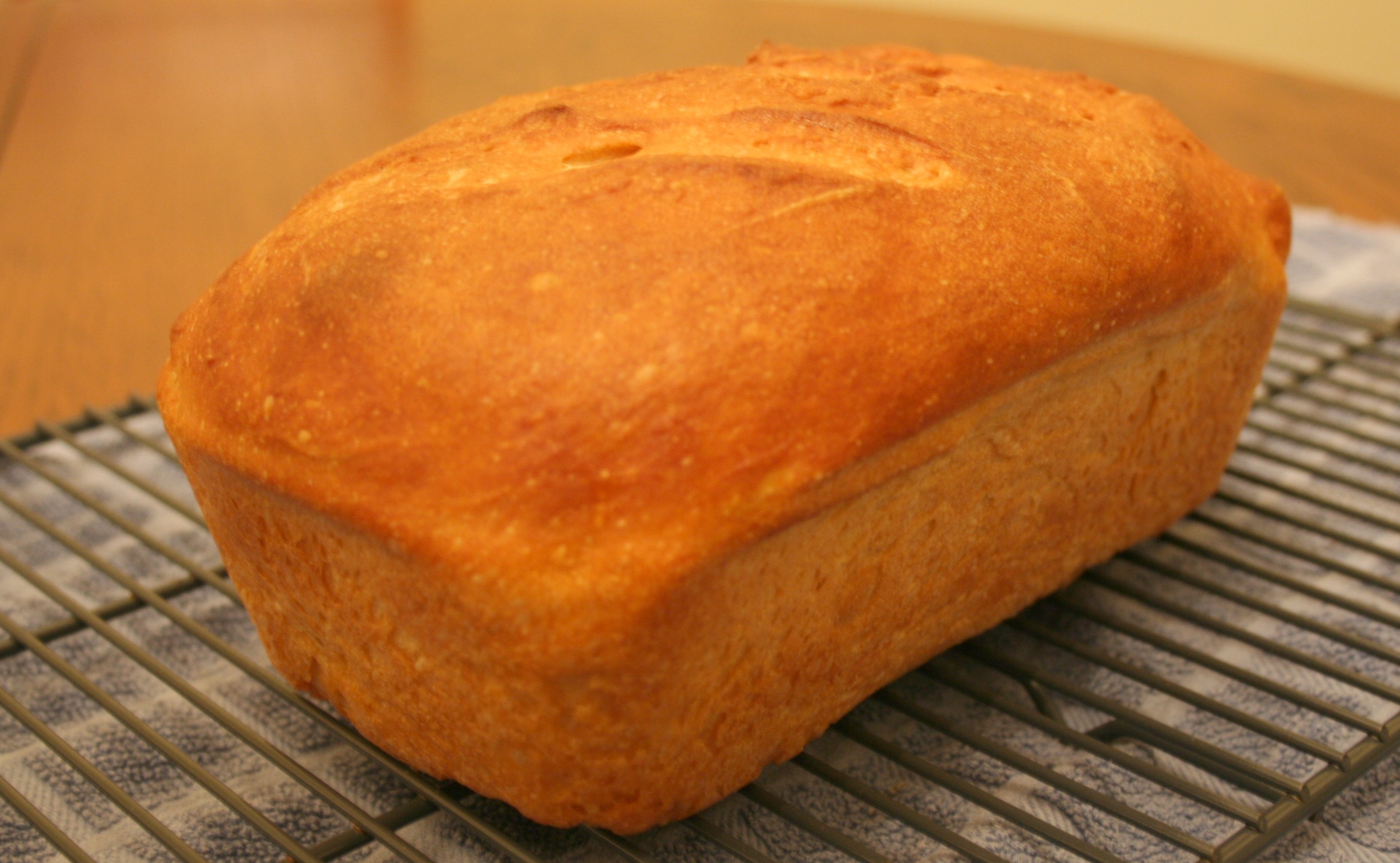
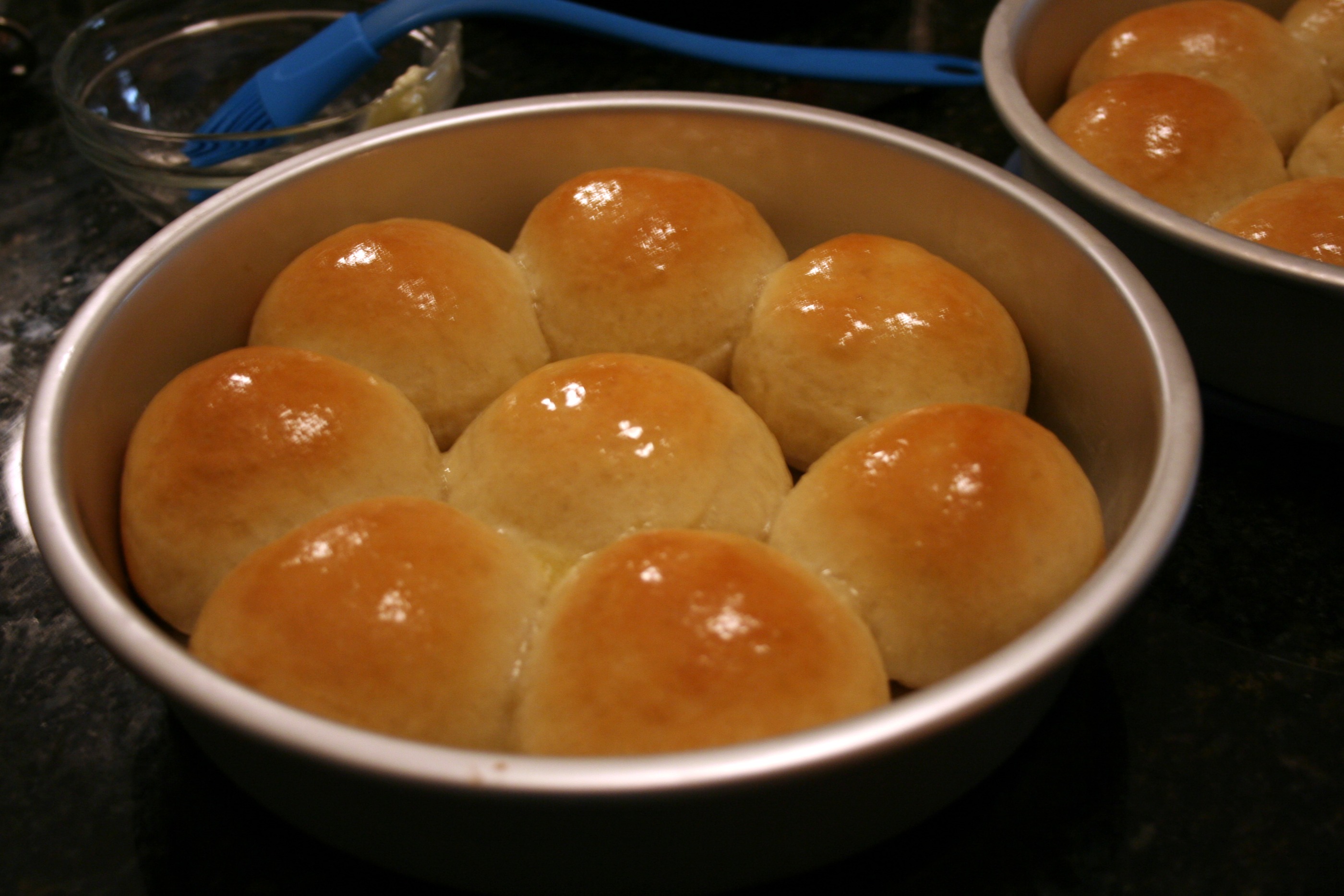
Golden Pull-Apart Butter Buns

I made these lovely little rolls to accompany the chicken noodle soup that I made Friday night. These tasted good, but I’m sure that if I could smell better (I’ve been stuffed up for the past week and a half…lack of smell always messes up my sense of taste), I could judge the flavor accurately. M and the kids seemed to enjoy them, but I’m still on the hunt for rolls that taste like Texas Roadhouse rolls – those are our favorites! Thanks for reading, enjoy!

Golden Pull-Apart Butter Buns – adapted from King Arthur Flour

  • 3 1/2 cups King Arthur Unbleached All-Purpose Flour
  • 2 teaspoons instant yeast
  • 2 tablespoons potato flour or 1/4 cup instant potato flakes
  • 3 tablespoons Baker’s Special Dry Milk or nonfat dry milk
  • 2 tablespoons sugar
  • 1 1/2 teaspoons salt
  • 4 tablespoons soft butter
  • 2/3 cup lukewarm water
  • 1/2 cup lukewarm milk

1. Combine all of the dough ingredients in a large bowl, and mix and knead — using your hands, a stand mixer, or a bread machine set on the dough cycle — to make a soft, smooth dough.

2. Place the dough in a lightly greased container — an 8-cup measure works well here — and allow the dough to rise for 60 to 90 minutes, until it’s just about doubled in bulk.

3. Gently deflate the dough, and transfer it to a lightly greased work surface.

4. Divide the dough into 16 equal pieces, by dividing in half, then in halves again, etc. Round each piece into a smooth ball.

5. Lightly grease two 8″ round cake pans. Space 8 buns in each pan. Can you use 9″ round cake pans, or a 9″ x 13″ pan? Sure; the buns just won’t nestle together as closely, so their sides will be a bit more baked.

6. Cover the pans, and allow the buns to rise till they’re crowded against one another and quite puffy, about 60 to 90 minutes. Towards the end of the rising time, preheat the oven to 350°F.

7. Uncover the buns, and bake them for 22 to 24 minutes, until they’re golden brown on top and the edges of the center bun spring back lightly when you touch it. An instant-read thermometer inserted into the middle of the center bun should register at least 190°F.

8. Remove the buns from the oven, and brush with the melted butter. After a couple of minutes, turn them out of the pan onto a cooling rack.

9.  Serve warm. Store leftovers well-wrapped, at room temperature. Makes 16 buns.

My Favorite Pizza Dough

This is the best one I have tried so far! I didn’t have to search long for what I consider to be the best homemade dough out there. I love that it makes a huge four pound batch of dough because I portion the dough out into 16 ounce balls and freeze them to use for the next few weeks. It comes together easily, is tasty and economical – always a bonus! I have to use my giant 6 quart lidded containers to let it double in – those were a great buy. I found them at Sam’s Club in the restaurant supplies section. I have been eyeing some other items there…so tempting! I love shopping for kitchen supplies – I just wish that we had more money to blow on new toys for me…hey, those are the kind of “toys” that benefit everyone.  Our eight year anniversary is coming up, so maybe I will be able to get some things that I wouldn’t normally justify;o) Anyway, enough rambling on about that – here’s the recipe! The directions that Jamie Oliver gives are for hand kneading the dough. I use my standing mixer, so I will tell you how I make it. Thanks for reading, enjoy!

Pizza Dough Ingredients – adapted from Jamie Oliver

  • 5 cups bread flour
  • 2 cups semolina flour
  • 1 level tablespoon fine sea salt
  • 2 (1/4-ounce) packets active dried yeast
  • 1 tablespoon raw sugar
  • 4 tablespoons extra-virgin olive oil
  • 2 1/2 cups lukewarm water

Directions –

If you’re using active dry yeast, get it started proofing in about 1/2 cup of your lukewarm water, all the raw sugar and extra virgin olive oil. While waiting for the yeast to wake up, measure out all your dry ingredients – by weight for the flour is best, then combine them in a large mixer bowl.  Measure out 2 cups of lukewarm water, I always use bottled from our water cooler because of the added chlorine in tap water . Add the proofed yeast mixture and the 2 cups of water to the flour. I stir the mix with my dutch whisk, (you can use your hand or a wooden spoon) then once I have formed a rough dough, I hand knead for about a minute until it becomes a little smoother. Using your standing mixer with the dough hook, knead the dough for 5 to 7 minutes on low until the dough is smooth and springy. Place the kneaded dough in a large, lightly oiled container to rise, then lightly cover the container. Let rest until doubled in bulk – about 1 hour. Weigh and divide the dough as needed. I use Ziploc quart sized bags with a little extra virgin olive oil poured in to prevent sticking. It’s also helpful to write the date and weight of the dough on the bag.

Banana Bread *UPDATE*

I found this recipe in a Peter Reinhart book called Crust and Crumb…I think. Anyway, it’s pretty fantastic banana bread – I only wish that my baking soda hadn’t expired! Both loaves sunk in the middle and I was so bummed. I warned M that the loaves didn’t look pretty but they tasted good. The next time I have at least 3 good sized bananas languishing away on my counter top, I will be sure to make this bread again. I stupidly made this the afternoon after I sprained my ribs – you’d be surprised how often  you move your rib cage around just doing subtle movements. Isn’t that the way it always is with an injury? It’s so easy to take your healthy, pain free body for granted until it’s not so healthy anymore. Thankfully the pain has subsided and I’m feeling a little more like myself everyday. The only thing I’m waiting on is this annoying cough! Anyway, this recipe says it makes two 8×4 loaves – it lied. I made two 9×5 loaves out of it. Thanks for reading, enjoy!

*UPDATE: I made this again March 17th with the following (successful) modifications. Two sticks of butter is an awful lot, so I tried using 1 1/2 sticks of unsalted butter instead. My other mod was to use 10 ounces of brown sugar and only 5 ounces of white sugar. I know these aren’t major changes, but when modifying any baked item you want to try small changes first. Baking is a science! These loaves looked better than the original recipe usually turns out. The top didn’t sink as much either, which was a nice surprise. It tastes sweet enough to me, and even M didn’t notice an objectionable difference – it’s still his favorite banana bread:) Thanks for reading!

Banana Bread Ingredients – adapted from Crust and Crumb

  • 16 ounces all-purpose flour (3 1/2 cups)
  • 1 TBSP baking powder
  • 1/2 TBSP baking soda
  • 1 tsp salt
  • 1 cup unsalted butter, room temperature
  • 20 ounces brown sugar, packed (2 1/2 cups)
  • 4 large eggs, room temperature
  • 2 tsp vanilla extract
  • 1 cup buttermilk
  • 20 ounces mashed, ripe bananas (2 1/2 cups)
  • 1 1/2 cups coarsely chopped walnuts (optional)

Directions –

1. Sift flour, baking soda, baking powder and salt.

2. Using a standing mixer fitted with the paddle attachment or using a hand mixer, cream butter and brown sugar until light and fluffy – about 2 minutes.

3. Mix in eggs one at a time, incorporating each egg before adding the next. Mix in vanilla and continue beating for 2 to 3 minutes until light and fluffy.

4. Mix in 1/3 of the dry ingredients, then 1/3 of the buttermilk, then 1/3 of the mashed bananas. Continue in this manner until all the ingredients are incorporated and the batter is smooth. Stir in walnuts.

5. Preheat oven to 350 degrees and grease two 9×5 loaf pans. Fill the pans 2/3 full with batter. Bake for 45 minutes then reduce the oven temperature to 325 degrees. Bake for an additional 15 minutes or until baked through. The safest way of knowing if they are finished is to test them with a probe thermometer. The internal temperature should be 180 – 185 degrees.

6. Let the loaves cool in the pans for 10 minutes, then turn them out on a rack to cool for at least one hour before slicing.

No Knead Sandwich Bread

I decided to try a new bread recipe this week, so I searched this book for a sandwich bread recipe. I’ve never made a no knead bread dough in a loaf pan before, I’ve only made free form round crusty loaves. My usual sandwich bread recipe calls for butter and sugar – both of which are not in this recipe. I’m hoping the flavor isn’t laking and that it is worth trying out. This recipe makes 4 pounds of dough which is enough for two 8×4 loaves. All ingredients and mixing, storing and baking directions can be found at this website. It’s too much to even copy and paste. However, those instructions are for a free form loaf, not one baked in a loaf pan. Instead of shaping the dough and placing it on the pizza peel, shape it into an elongated oval and place it in a lightly oiled loaf pan. Follow the rising and “Baking Day” directions as written, but leave the loaf in the oven for 40 to 45 minutes. There seems to be way too many steps for this to be a simpler method of bread making, but once you get the hang of the technique it couldn’t be easier. Here’s hoping this a tasty bread recipe! Thanks for reading, enjoy!

Sandwich Bread

With the appliance rebate we received a few months ago, I bought my KitchenAid standing mixer. Best. Appliance. Ever. M talked me into getting one of the largest models available – and this was it. I was hesitant at first thinking I would never need such a large capacity, but I’m glad I took his advice. I use it several times a week  – it’s so powerful and convenient, especially when it comes to bread making. I have only tried hand kneading once but when I use this, it takes all of the guess work out of the process. All the bread I have made since I started using the KitchenAid has come out perfectly. It’s so nice to let the machine do all the hard work because if I didn’t have it, I would have to hand knead for at least 10 minutes – no thanks! Since it’s purchase in July, I haven’t bought a loaf of bread! Let me tell you – the difference is like night and day when comparing taste and quality. I used to make this with plain bread flour but about a month ago I started adding white whole wheat in combination with it. White whole wheat is milled from white spring wheat rather than the traditional red wheat and it’s lighter in color and milder tasting. If you buy this type of wheat flour, it’s recommended that you store it in the freezer to prolong shelf life. I keep this, my whole wheat and my semolina flour all in the freezer just to be safe. On this blog I will be sure to post all the different recipes that I try. I have so many bookmarked from other blogs, like a cinnamon swirl bread, brioche, Challah, dinner rolls, oatmeal bread…the list goes on.

This is my go to recipe for sandwich bread and I often double it to freeze the other loaf for later on in the week. We easily go through these two loaves before the weekend, and I have found that freezing the bread doesn’t change the taste or texture. Thanks for reading! I look forward to sharing more bread recipes with you.

White Sandwich Bread – adapted from King Arthur Flour

  • 1 packet “highly active” active dry yeast; or 2 1/2 teaspoons active dry yeast; or 2 1/2 teaspoons instant yeast
  • 7 to 9 ounces lukewarm water
  • 12 3/4 ounces of unbleached all-purpose flour, bread flour or a combination of bread flour and white whole wheat flour (I use 5 1/4 ounces of whole white wheat and 7 1/2 ounces of bread flour)
  • 1 1/4 tsp of salt (I use bread salt)
  • 3 TBSP sugar (I use raw sugar)
  • 6 TBSP unsalted butter, room temperature
  • 1/4 cup Baker’s Special Dry Milk or non fat dry milk
  • 1/2 cup instant mashed potato flakes
  • 1/2 – 1 tsp of diastatic malt powder, optional (it helps prolong shelf life)

Directions –
1.  If you’re using active dry yeast, dissolve it with a pinch of sugar in 2 tablespoons of the lukewarm water. Let the yeast and water sit at room temperature for 15 minutes, until the mixture has bubbled and expanded. If you’re using instant yeast, you can skip this step.
2. Combine the dissolved yeast (or instant yeast) with the remainder of the ingredients. Mix and knead everything together—by hand, mixer or bread machine set on the dough cycle—till you’ve made a smooth dough. If you’re kneading in a stand mixer, it should take about 7 minutes at second speed, and the dough should barely clean the sides of the bowl, perhaps sticking a bit at the bottom. In a bread machine (or by hand), it should form a smooth ball.
3. Place the dough in a lightly greased bowl. Cover the bowl, and allow the dough to rise, at room temperature, for 1 to 2 hours, or until it’s nearly doubled in bulk. Rising may take longer, especially if you’ve kneaded by hand. Give it enough time to become quite puffy.
4. Gently deflate the dough and shape it into an 8″ log.
5. Transfer the log, smooth side up, to a lightly greased 8 1/2″ x 4 1/2″ loaf pan. Tent the pan loosely with lightly greased plastic wrap.
6. Allow the bread to rise till it’s crested about 1 1/4″ over the rim of the pan, about 1 hour. Again, it may rise more slowly for you; let it rise till it’s 1 1/4″ over the rim of the pan, even if that takes longer than an hour. While the dough is rising, preheat the oven to 350°F.
7. Bake the bread for 15 minutes. Tent it lightly with aluminum foil, and bake for an additional 20 to 25 minutes, till the crust is golden brown, and the interior temperature measures 190°F on an instant-read thermometer.
8. Remove the bread from the oven, and gently loosen the edges with a heatproof spatula or table knife. Turn it out of the pan, and brush the top surface with butter, if desired; this will give it a soft, satiny crust. Allow the bread to cool completely before slicing. As soon as it’s completely cool, wrap it tightly in plastic wrap; or in a plastic bag, air pressed and fastened securely at the top.